 c6ceaea899
A queued/downloading row previously showed the bare video id and no thumbnail because asset metadata was only filled when the download completed. Now: - service.populate_from_catalog fills title/uploader/thumbnail/date/duration at enqueue from our own Video/Channel catalog (0 network cost) — feed downloads look right instantly - worker fills the same from yt-dlp's info_dict on the first progress event (covers ad-hoc URLs / catalog misses), best-effort, never fails a download Verified: a paused feed download now shows its real title, channel, thumbnail and duration. |
||
|---|---|---|
| backend | ||
| docs | ||
| frontend | ||
| scripts | ||
| .dockerignore | ||
| .env.example | ||
| .gitattributes | ||
| .gitignore | ||
| docker-compose.localdev.yml | ||
| docker-compose.selfhost.yml | ||
| docker-compose.yml | ||
| Dockerfile | ||
| install.ps1 | ||
| install.sh | ||
| README.md | ||
| VERSION | ||
Siftlode
Your YouTube subscriptions, the way a feed should work. Siftlode pulls every upload from the channels you follow into one clean, filterable feed — no algorithm deciding what you see, and no Shorts or livestream noise unless you want it. Self-hosted, multi-user, and private: your data stays on your own server.
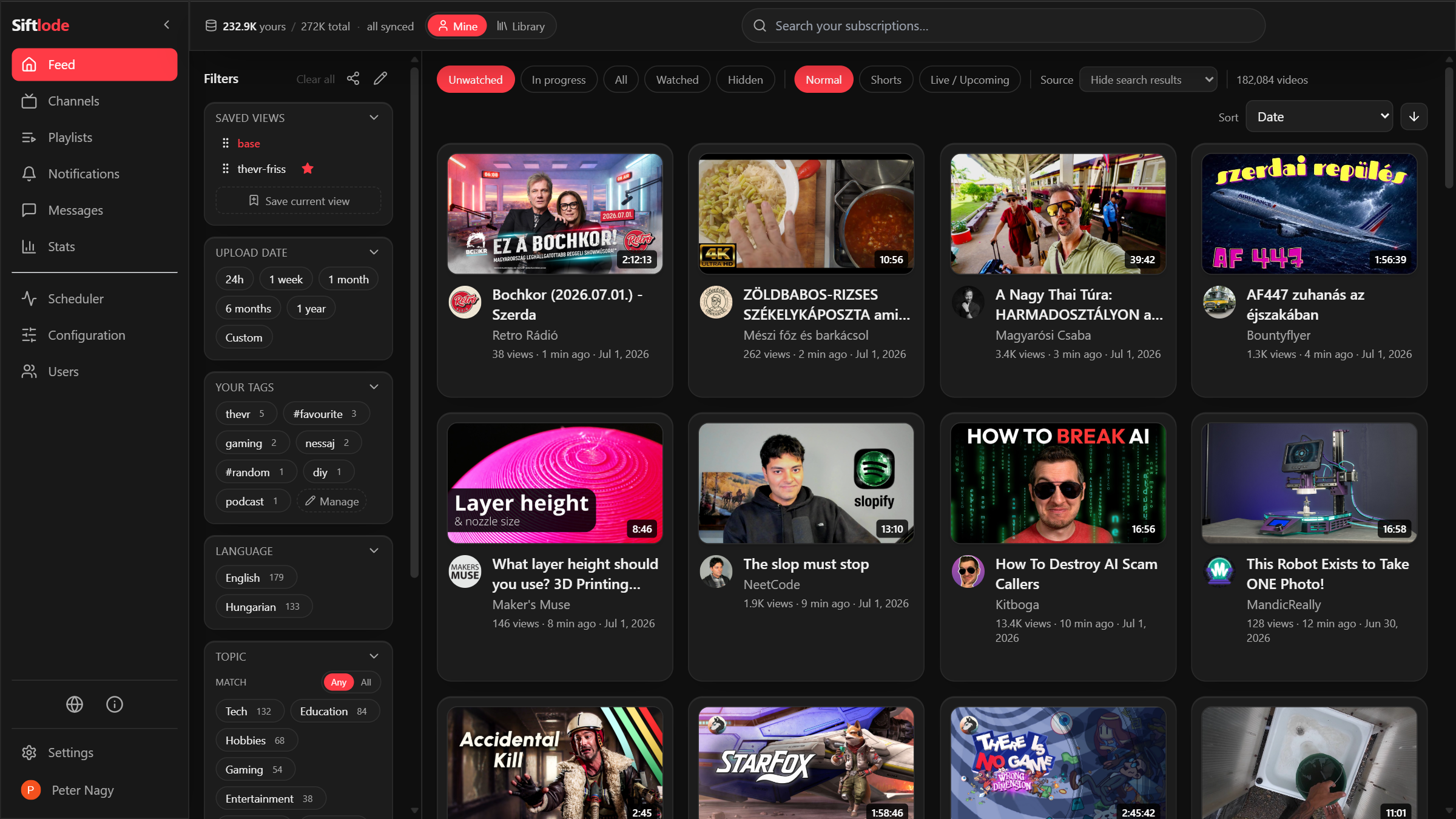
Everything expensive (channels, videos, metadata) is fetched from YouTube once and stored locally, so filtering, searching and sorting are instant and don't burn API quota. Click a video to watch it in an in-app player that resumes where you left off — or open it on youtube.com so your own ad blocker and SponsorBlock keep working.
Features
- A readable subscription feed — sort and filter by channel, tag, language, topic, length, upload date or watch state; hide channels without unsubscribing; save filter setups as named views.
- Search all of YouTube from the feed — results play, save and add to playlists like any other video, and are materialised into your catalog.
- Channel pages & a channel manager — per-channel stats and uploads, priorities, and your own tags to slice the feed by.
- Playlists with two-way YouTube sync — build them locally, keep them in sync in both directions.
- In-app player with resume, plus keyboard/scroll controls.
- Multi-user with per-user private state, a shared catalog, and a fair daily API-quota guard.
- Self-hosted & private, with a first-run web setup wizard and the interface in English, Hungarian and German.
Quick start (self-hosting)
You don't need to build anything — Siftlode runs from a prebuilt public image, and all configuration (your admin account, Google sign-in, email) happens in a first-run web wizard. You need Docker with the Compose plugin.
1. Get the files and run the installer:
git clone https://forge.b1fr0st.eu/peter/siftlode.git
cd siftlode
./install.sh          # Windows (PowerShell):  ./install.ps1
The installer generates a private .env (secrets), pulls the image, starts the app + database, and
prints a one-time setup URL like http://localhost:8080/setup?token=….
2. Finish in your browser. Open that URL and follow the wizard:
- Admin account — the email + password you'll sign in with.
- Google sign-in (optional) — paste a Google OAuth client to enable "Sign in with Google" and pulling your YouTube subscriptions. Skip it to use email + password only.
- Email / SMTP (optional) — for verification/notification emails. Skip it and you (the admin) simply approve new accounts yourself.
Then sign in with your admin account. That's it. See docs/self-hosting.md for the full walkthrough.
Just trying it out? Press Enter at the installer's URL prompt to run on
http://localhost:8080.
Build from source (alternative)
Prefer to build the image yourself instead of pulling it:
git clone https://forge.b1fr0st.eu/peter/siftlode.git
cd siftlode
cp .env.example .env
# generate the two secrets and paste them into .env:
python -c "import secrets;print('SECRET_KEY='+secrets.token_urlsafe(48))"
python -c "import base64,os;print('TOKEN_ENCRYPTION_KEY='+base64.urlsafe_b64encode(os.urandom(32)).decode())"
docker compose up --build -d      # builds from the included Dockerfile
Open http://localhost:8080 and finish in the setup wizard as above. (Set a POSTGRES_PASSWORD in
.env too.)
HTTPS / public access
Port 8080 over plain HTTP is fine for a LAN or a quick trial. For public access put a reverse
proxy (Caddy, Nginx, Traefik…) in front to terminate TLS, and set the public URL (the installer
prompt, or OAUTH_REDIRECT_URL in .env) to your https://… address — this also marks the session
cookie secure. Add that same …/auth/callback URL to your Google OAuth client's authorized redirect
URIs.
Updating & backups
docker compose -f docker-compose.selfhost.yml pull   # or: docker compose pull
docker compose -f docker-compose.selfhost.yml up -d
Database migrations run automatically on startup. Your data (accounts, subscriptions, playlists, the
video catalog) lives in a Postgres volume — back it up with scripts/backup.sh (or backup.ps1 on
Windows) and restore with scripts/restore.sh.
How it works
- Shared catalog, private state. Channels and videos are stored once and shared; each user's subscriptions, tags, playlists and watch/save/hide state are private.
- Cheap by design. Public reads are cached locally; a shared daily quota budget and a background scheduler keep unattended syncing within YouTube's free API limits. An optional API key lets backfill run without depending on a user's OAuth token.
Tech
FastAPI + PostgreSQL (SQLAlchemy, Alembic) backend; React + Vite + Tailwind + TanStack Query frontend; packaged as a single Docker image with Docker Compose.
Note
This project is developed with AI assistance.